
How to learn Morse code by ear, not from a chart
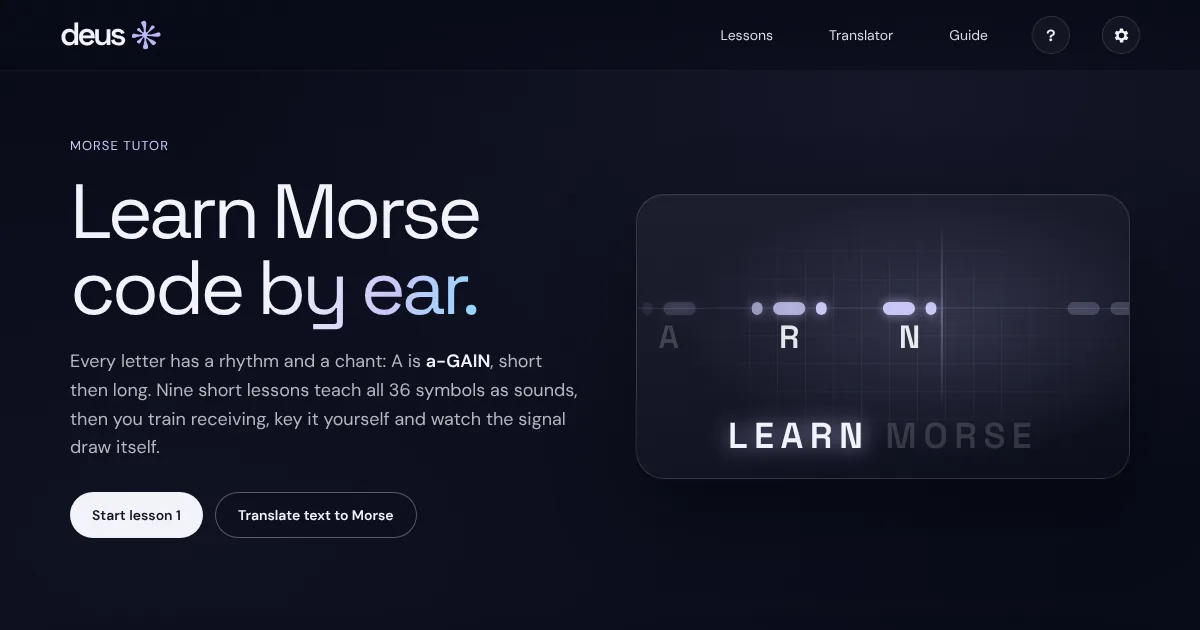
Most people start learning Morse code with a chart of dots and dashes. It works for the first week. Then they get stuck around 5 words per minute, because every letter turns into counting: dot, dash, dash... that's W. At real speed there is no time to count.
Radio operators learn it differently. Morse is a language for the ear, and each letter is a short rhythm you recognise the way you recognise a word. Here is how to learn it like that, and a free trainer that does it for you.
Why the chart is a trap
A chart teaches you to see Morse. Your brain then translates every sound into a picture and the picture into a letter. That extra step is what caps your speed, and it's hard to unlearn later. So the rule is simple: never learn a symbol from its dots and dashes. Learn it from its sound, and test yourself by ear only.
1. Hear every symbol at full speed
If you learn letters played slowly, you learn slow letters, and you'll have to learn them again when they get faster. Play each symbol at a real character speed of 15 to 20 WPM from day one. At that speed you can't count the parts, so you remember the whole rhythm.
To give yourself time to think, stretch the pauses between symbols instead. This is called Farnsworth timing: letters at 18 WPM, overall speed around 8 WPM. As you improve, shrink the gaps until both speeds match.
2. Give every rhythm a chant
A chant is a word or phrase with the same rhythm as the symbol, where stressed syllables are dashes. Radio schools have used them for decades, and they make the first week much easier:
- A · − is a-GAIN
- B − · · · is BOB-is-the-man
- Q − − · − is GOD-SAVE-the-QUEEN
- V · · · − is vic-to-ri-A, the same rhythm as the opening of Beethoven's Fifth
The chant is a bridge from rhythm to letter. After a few weeks the letter comes on its own and the chant fades away. That's the goal.
3. Learn in small groups, then mix
Don't learn the alphabet in order. Take four letters, drill them until you name them instantly, add the next four and keep mixing in the old ones. Start with letters whose rhythms sound very different, such as A, I, M and N, so you don't confuse them early. Your mistakes tell you what to repeat: drill the letters you miss, not the ones you already know.
4. Copy random groups, then real text
Once you know a dozen letters, start receiving: listen to random five-letter groups and type what you hear. Random letters are better than words at first because you can't guess them from context. Later move to common words, amateur radio abbreviations like CQ, 73 and RST, and call signs. Write down what you're sure of and skip what you missed. Stopping on a missed letter makes you lose the next three.
5. Send it yourself
Sending trains the same rhythm from the other side. The thing to watch is timing: a dash is three times as long as a dot, and the gaps matter as much as the sounds. Beginners usually send dashes too short and run letters together.
| Element | Length |
|---|---|
| Dot | 1 unit |
| Dash | 3 units |
| Gap inside a letter | 1 unit |
| Gap between letters | 3 units |
| Gap between words | 7 units |
Speed is measured with the word PARIS, which is exactly 50 units long, so one unit lasts 1200 ÷ WPM milliseconds: 80 ms at 15 WPM, 60 ms at 20 WPM.
A 4-week plan
- Week 1: the first 12 letters, 10 to 15 minutes a day, with chants.
- Week 2: the rest of the alphabet. Review weak letters every day.
- Week 3: digits, then receiving random groups at 18/8 WPM.
- Week 4: words and call signs, sending practice, raise the overall speed to 12 WPM.
Short daily sessions beat long weekly ones. Ten minutes every day for a month is enough to know all 36 symbols by ear.
Practice in your browser
Morse Tutor is a free trainer built on exactly this method, made by the author of Deus. It runs in the browser with no account and keeps your progress on your device.
- Nine short lessons cover all letters and digits. Each one plays the symbols with their chants, then asks you to name them by ear, and every mistake goes into a weak-symbol review.
- Receiving plays random groups, words, call signs or only the letters you've learned, and shows what you missed.
- Sending turns the Space bar into a telegraph key. A signal tape draws your dots and dashes over the ideal timing and tells you which one ran long.
- Translator converts text to Morse and back, plays it, and saves it as a WAV file.
Character speed, Farnsworth spacing, pitch and tone are all in the settings. Open the trainer and start lesson 1: the first letter takes about a minute.