Presets · WebGL
Brian's Brain
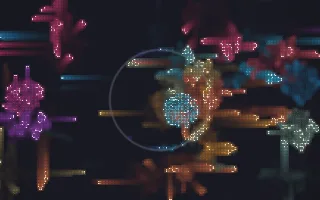
Watch Brian's Brain live in the browser
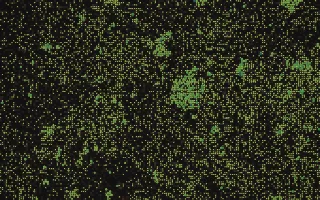
A dark grid fills with tiny sparks: white-hot points with coloured afterglows that run in short trains across the screen, cross, collide and break into new trains, leaving fading ember trails. A faint ring sits in the middle.
The rule is Brian Silverman's Brian's Brain, a cellular automaton with three states. A ready cell fires when exactly two of its eight neighbours are firing, a firing cell becomes refractory, and a refractory cell becomes ready again. Because a cell cannot fire twice in a row, sparks always move away from where they came from, which gives the rule its well-known gliders. Here cells sometimes miss their cue, so activity dies out unless the music keeps feeding it, and each spark inherits the colour of the cells that lit it.
What it reacts to
- Spectrum: the central ring is the spectrum, and each band sparks its arc in proportion to its level
- Kick drum: a burst of sparks at a random spot, wider with more bass
- Snare: a short, straight fuse of sparks somewhere on the grid
- Loudness: sets how fast the automaton steps; silence stops it mid-pattern
- Treble: firing cells burn brighter
Tune
Speed scales the step rate, Excitability sets how reliably a ready cell fires on its cue (lower values let activity die out sooner), and Spark tints the firing cells.
Music that suits it
Busy, percussive music with frequent kicks and snares, such as drum and bass, breakbeat or techno, keeps the grid crowded with gliders.
How to play it
Install Deus, play music on Spotify, YouTube Music, Yandex Music or any other tab and click the Deus icon on that tab. Then pick Brian's Brain in the WebGL presets, or press ← → on the page until it comes up.